Friday, September 20, 2019

Clear, concise, and effective English for law students, bar examinees, and legal writers in organizations, private companies, and government offices (26): Oxford comma (serial comma) cases, resources, and infographics

Sentence without Oxford comma:

I’d like to thank my parents, Ayn Rand and God.
Sentence with Oxford comma:


I’d like to thank my parents, Ayn Rand, and God.

1. From Wikipedia: “In English language punctuation, a serial comma or series comma (also called an Oxford comma or a Harvard comma) is a comma placed immediately before the coordinating conjunction (usually and or or) in a series of three or more terms. For example, a list of three countries might be punctuated either as ‘France, Italy, and Spain’ (with the serial comma), or as ‘France, Italy and Spain’ (without the serial comma).”

“A majority of American style guides mandate use of the serial comma, including APA style, The Chicago Manual of Style, The MLA Style Manual, Strunk and White’s Elements of Style, and the U.S. Government Printing Office Style Manual.”

2. The Oxford comma is perhaps the most contentious issue in English grammar. Bur for legal writing, this issue has long been settled by numerous experts such as Bryan Garner, Joseph Kimble, Mark Painter, and Richard Wydick; they all recommend using the Oxford comma to avoid ambiguity or confusion. For example, based on Garner’s guidelines for drafting court rules, the Oxford comma was used in the Plain English restyling of all the US Federal Rules of Court.

3. Cases involving the Oxford comma:

(a) “Peterson vs. Midwest Security Insurance Company,” Supreme Court of Wisconsin, 2001: the lack of a serial comma created an ambiguity in Wisconsin’s recreational immunity statute.

(b) “O’Connor versus Oakhurst Dairy” US Court of Appeals, First Circuit, 2017

For want of a comma, we have this case. It arises from a dispute between a Maine dairy company and its delivery drivers, and it concerns the scope of an exemption from Maine's overtime law.
Specifically, if that exemption used a serial comma to mark off the last of the activities that it lists, then the exemption would clearly encompass an activity that the drivers perform. And, in that event, the drivers would plainly fall within the exemption and thus outside the overtime law's protection. But, as it happens, there is no serial comma to be found in the exemption's list of activities, thus leading to this dispute over whether the drivers fall within the exemption from the overtime law or not.

4. The “Ombudsman Stylebook” recommends the nuanced use of the serial comma. Posted below is the Stylebook’s complete guideline:
Note: Click the graphic above to view
or download the Ombudman Stylebook.
3.2.3. Use commas to separate items in a series (three or more items).

Such commas are called serial commas. If the last two items in the series are obviously different from each other, do not insert a comma.

Examples:

a. The signatories to the contract represented the governments of Greece, Spain and Italy.

b. The terms of the sale were reviewed by the executive director, the chief accountant and the cashier.

c. The virus spread in the U.S., Asia and Europe

Sometimes inserting a comma between the last two items in a series is necessary to improve comprehension. Such comma distinguishes these two items from the others in a complex list.

Examples:

a. The directive required the department to revise the curriculum, review the textbooks given to the students at the beginning and end the teachers‘ strike. [Note: Without a comma before and, the reader might mistake end for a noun instead of a verb.]

b. The Center for Culinary Arts offers several courses: Bartending, Kitchen Safety, Food Equipment, Environmental Impact, Baking and Cooking. [Note: Without a comma before and, it is not clear if Baking and Cooking is one course, or if Baking is a different course from Cooking.].

Critique of the guideline:

It’s better to follow Garner’s guideline of using the Oxford comma consistently. The Stylebook’s guideline assumes that the reader is able to know the reason why the serial comma was used in one sentence but not in another sentence. But legal writers are responsible for thinking through what they want to say and to make everything clear for their readers.

5. Infographics on the Oxford comma:

Note: Click the graphic above to view or download the full infographic.

Note: Click the graphic above to view or download the full infographic.


Free seminars:

1. “English Proficiency Course” (4 hours; for college students, K-to-12 teachers, other groups)

2. “Clear, concise English for effective legal writing” (3-5 hours; for Student Councils, academic organizations, fraternities, sororities, NGOs, LGUs, any interested group; test yourself with the interactive exercises)

Seminars are for Metro Manila only. For more information or to schedule a seminar, please contact Atty. Gerry T. Galacio at 0927-798-3138.

Be a better writer or editor through StyleWriter 4: this software checks 10,000 words in 12 seconds for hundreds of style and English usage issues like wordy and complex sentences, passive voice, nominalization, jargon, clichés, readability, spelling, etc.

StyleWriter 4 graphs your style and sentence variety, and identifies your writing habits to give an instant view of your writing. You can learn to adjust your writing style to suit your audience and task. You can learn, for example, the writing style of Newsweek, Time, The Economist, and Scientific American.

StyleWriter 4 is widely used in the US federal government (for example, the Environmental Protection Agency). It can be used by educators, students, and professionals in various fields - business, law, social or physical science, medicine, nursing, engineering, public relations, human resources, journalism, accounting, etc. Download your free 14-day trial copy now.

Friday, September 13, 2019

Clear, concise, and effective English for law students, bar examinees, and legal writers in organizations, private companies, and government offices (25): Million-dollar comma case; resources and infographics on commas

1. The “million-dollar comma case” was a 2006 dispute between Rogers Communication (a cable company) and Bell Aliant (a telephone company). It involved the use of more than 90,000 utility poles scattered across Canada’s easternmost provinces; value of the contract was around 900,000 Canadian dollars.

Issues:

How long is the duration of the contract? Can Bell Aliant cancel its contract with Rogers at any time, even before end of the term?

Background facts:

Date of execution of the contract between Rogers Communication and Bell Aliant was May 31, 2002.

The issues revolved around the interpretation of the following clause:

“This agreement shall be effective from the date it is made and shall continue in force for a period of five (5) years from the date it is made, and thereafter for successive five (5) year terms, unless and until terminated by one year prior notice in writing by either party.”

The problem begins:

New Brunswick Power Distribution and Customer Service Corporation (NB Power) actually owned the poles, not Bell Aliant. In 2004, NB Power terminated its contract with Bell Aliant.

In October 2004, NB Power began invoicing Rogers Communication for the use of its poles at a rate of $18.91 per pole per year.

On January 31, 2005: Bell Aliant provided Rogers Communication notice of termination of the 2002 agreement, effective February 1, 2006.

Rogers Communication filed a suit with the Canadian Radio-Television Telecommunications Commission (CRTC), saying that Bell Aliant could not terminate its contract without cause before May 31, 2007.

Opposing interpretations by the contracting parties:

Rogers Communication: Contract was good for at least five years, from May 31, 2002 to May 31, 2007. The contract will automatically renew for another five years, unless either party cancels the contract before the start of the final 12 months.

Bell Aliant: Contract can be terminated even before May 31, 2007, as long as one year’s notice is given. Reason: The second comma in the disputed clause located between the words “terms” and “unless”:

“This agreement shall be effective from the date it is made and shall continue in force for a period of five (5) years from the date it is made, and thereafter for successive five (5) year terms, unless and until terminated by one year prior notice in writing by either party.”

Who won the case?

First ruling of the CRTC:

Citing the “rules of punctuation,” CRTC ruled in favor of Bell Aliant. The placement of the second comma allowed Bell Aliant to end its five-year agreement with Rogers at any time with notice.

Final ruling of the CRTC:

CRTC ruled in favor of Rogers Communication, citing that the French version of the contract provided clear evidence that the parties intended to restrict termination without cause to the end of the term.

2. Kenneth Adams, a lawyer specializing in drafting of contracts and lecturer at the University of Pennsylvania Law School, was a consultant for Rogers Communication. He offered his rewrite of the disputed clause:

“The initial term of this agreement ends at midnight at the beginning of the fifth anniversary of the date of this agreement. The term of this agreement (consisting of the initial term and any extensions in accordance with this section) will automatically be extended by consecutive five-year terms unless no later than one year before the beginning of any such extension either party notifies the other in writing that it does not wish to extend this agreement.”

Prof. Adams explains why legal contracts are convoluted and oftentimes unintelligible: “Because any given transaction will closely resemble many previous transactions, and because lawyers tend to be risk-averse and wary of change, as things stand contract drafting is essentially an exercise in regurgitation. Add to that the specialized nature of contract language—it’s akin to a cross between regular writing and computer code—and it’s not surprising that business contracts are riddled with redundancies, archaisms, misconceptions, and other drafting glitches.”

A Financial Times article quotes Prof. Adams as saying: “The dirty little secret of the Anglo-American drafting style that dominates global transactions is that nobody drafts contracts from scratch.”

3. PDF resources on commas by Judge Gerald Lebovits: “The Pause That Refreshes: Commas” and “The Pause That Refreshes: Commas—Part 2”

“Commas, like all punctuation, have many uses, including writing persuasively. Punctuation can speed readers up or slow them down. Em dashes (“—”) grab readers, semicolons pause, periods arrest. Recast sentences to add or excise commas if you want your reader to get through your material slowly or quickly.”

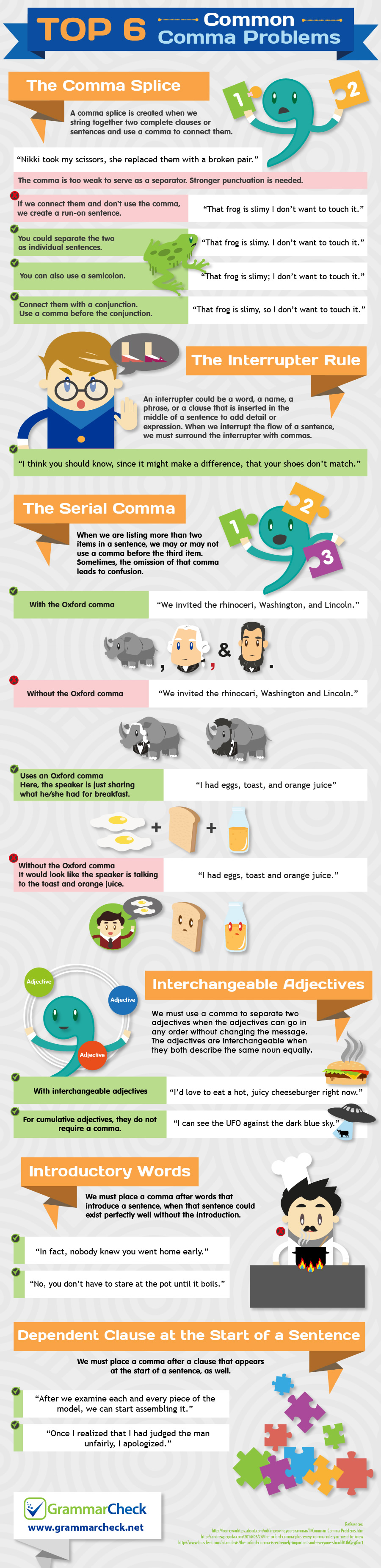
4. Infographic from GrammarCheck: “Top 6 Commmon Comma Problems”

Click the graphic above to view or download the full infographic

5. 2019 Canadian case involving commas: “An attempted class action suit against Bell Canada failed after plaintiffs lost a debate over commas and rounded numbers”

“The Ontario Superior Court of Justice was asked last month to consider how Bell Canada calculates its yearly cost of living increase for pensioners. The plaintiffs alleged that Bell did its math wrong, and the increase for 2017 should have been two per cent. Bell said it did the calculation correctly and the increase should be one per cent. It all came down to a question of math — and grammar.”

“This, of course, may seem an odd, or perhaps an excessively minute detail to be determinative of a case that impacts on some 35,000 pensioners of the Bell Canada corporate family.”

The controversy lies with the interpretation of the following sentence:

‘Pension Index’ means the annual percentage increase of the Consumer Price Index, as determined by Statistics Canada, during the period of November 1 to October 31 immediately preceding the date of the pension increase.

The judge based his ruling on the placement of the comma: “Since there is a comma preceding the modifier, the opposite of the last antecedent rule — often dubbed the ‘series qualifying rule’ — is applied. ”

Contracts guru Kenneth Adams criticizes the Canadian court’s ruling in “More Comma Confusion: The Opinion of the Ontario Superior Court of Justice in Austin v. Bell Canada.”

6. The power of a comma from “Should Lawyers Punctuate” by Richard C. Wydick (The Scribes Journal of Legal Writing, Vol 1, 1990):

Fifth Amendment, US Constitution

“[No person shall] be deprived of life, liberty, or property, without due process of law . . .”

The comma after “property” tell us that the phrase “due process of law” modifies the verb “be deprived”.

Without the comma after “property,” it would permit a lawyer to argue (in defiance of the provision’s long history) that “without due process” modifies only “property.” Thus, the fifth amendment would forbid deprivation of property without due process and would absolutely forbid both incarceration and the death penalty.

Comparing the 1987 Philippine Constitution and the US Constitution

The Bill of Rights of the 1987 Constitution was patterned after that of the US Constitution. Notice, however, that there's no comma after “property” in Section 1 of Article III.  

Fifth Amendment, US Constitution

No person shall be held to answer for a capital, or otherwise infamous crime, unless on a presentment or indictment of a grand jury, except in cases arising in the land or naval forces, or in the militia, when in actual service in time of war or public danger; nor shall any person be subject for the same offense to be twice put in jeopardy of life or limb; nor shall be compelled in any criminal case to be a witness against himself, nor be deprived of life, liberty, or property, without due process of law; nor shall private property be taken for public use, without just compensation.
1987 Constitution, Article III, Bill of Rights

Section 1. No person shall be deprived of life, liberty, or property without due process of law, nor shall any person be denied the equal protection of the laws.

Note: “Wydick served as Acting Dean of the [UC Davis] Law School in 1978-80 and received the Distinguished Teaching Award in 1983. He has authored books on ethics, evidence, and good writing, including the esteemed legal writing guide, ‘Plain English for Lawyers.’

“Wydick has received honors including the Golden Pen Award from the Legal Writing Institute and a lifetime achievement award from Scribes, the American Society of Legal Writers, in recognition of his contributions to legal writing.”

Free seminars:

1. “English Proficiency Course” (4 hours; for college students, K-to-12 teachers, other groups)

2. “Clear, concise English for effective legal writing” (3-5 hours; for Student Councils, academic organizations, fraternities, sororities, NGOs, LGUs, any interested group; test yourself with the interactive exercises)

Seminars are for Metro Manila only. For more information or to schedule a seminar, please contact Atty. Gerry T. Galacio at 0927-798-3138.

Be a better writer or editor through StyleWriter 4: this software checks 10,000 words in 12 seconds for hundreds of style and English usage issues like wordy and complex sentences, passive voice, nominalization, jargon, clichés, readability, spelling, etc.

StyleWriter 4 graphs your style and sentence variety, and identifies your writing habits to give an instant view of your writing. You can learn to adjust your writing style to suit your audience and task. You can learn, for example, the writing style of Newsweek, Time, The Economist, and Scientific American.

StyleWriter 4 is widely used in the US federal government (for example, the Environmental Protection Agency). It can be used by educators, students, and professionals in various fields - business, law, social or physical science, medicine, nursing, engineering, public relations, human resources, journalism, accounting, etc. Download your free 14-day trial copy now.

Friday, September 06, 2019

Clear, concise, and effective English for law students, bar examinees, and legal writers in organizations, private companies, and government offices (24): 20 Writing Mistakes Even Native Speakers Make (Infographic)

20 Writing Mistakes Even Native Speakers Make (infographic) from GrammarCheck

Click the graphic above to view or download
the full infographic (2.48 MB, 900 by 7650 px)

Interactive exercises with time limit and automatic scoring:

Interactive exercises in grammar (than - then)

Interactive exercises in grammar (its - it’s)

Interactive exercises in grammar (their -they’re)

Interactive exercises in grammar (who’s – whose; your - you’re)

Relevant resource: “The Infographic Guide to Grammar: A Visual Reference to Everything You Need to Know”

Mastering grammar is now easier than ever with this fully illustrated guide that covers the most important rules in grammar and punctuation — making even the most confusing rules easy to understand.

This illustrated guide to English grammar gives you everything you need for a better understanding of how to write and punctuate correctly. From proper comma usage to the correct form of there, their, or they’re — understanding grammar has never been easier.

Is it who or whom? Affect or effect? And what is a prepositional phrase? With “The Infographic Guide to Grammar,” you’ll learn the answers to all of these questions, and so much more. Featuring 50 vibrant infographics explaining everything from subject-verb agreement to the Oxford comma and verb tenses this book breaks down the complicated rules and guidelines for writing the English language and makes them clear and straightforward.

Free seminars:

1. “English Proficiency Course” (4 hours; for college students, K-to-12 teachers, other groups)

2. “Clear, concise English for effective legal writing” (3-5 hours; for Student Councils, academic organizations, fraternities, sororities, NGOs, LGUs, any interested group; test yourself with the interactive exercises)

Seminars are for Metro Manila only. For more information or to schedule a seminar, please contact Atty. Gerry T. Galacio at 0927-798-3138.

Be a better writer or editor through StyleWriter 4: this software checks 10,000 words in 12 seconds for hundreds of style and English usage issues like wordy and complex sentences, passive voice, nominalization, jargon, clichés, readability, spelling, etc.

StyleWriter 4 graphs your style and sentence variety, and identifies your writing habits to give an instant view of your writing. You can learn to adjust your writing style to suit your audience and task. You can learn, for example, the writing style of Newsweek, Time, The Economist, and Scientific American.

StyleWriter 4 is widely used in the US federal government (for example, the Environmental Protection Agency). It can be used by educators, students, and professionals in various fields - business, law, social or physical science, medicine, nursing, engineering, public relations, human resources, journalism, accounting, etc. Download your free 14-day trial copy now.

Thursday, August 29, 2019

Clear, concise, and effective English for law students, bar examinees, and legal writers in organizations, private companies, and government offices (23): Typography and visual design for pleadings, motions, court and other legal documents

Jump to: Efficient Use of Paper Rule A.M. No. 11-9-4-SC; Save forests, use Plain English; Proposed Rules on E-Filing A. M. 10-3-7-SC; Typography in briefs and other papers, from US 7th Circuit Court of Appeals; US SEC design guidelines; How to create a PDF
1. “Typography for Lawyers, Essential Tools for Polished and Persuasive Documents” by Matthew Butterick (California-based lawyer; graduated magna cum laude from Harvard University in visual and environmental studies; designed fonts for Apple and Microsoft; awarded the Legal Writing Institute’s 2012 Golden Pen Award)
Good typography is part of good lawyering.

Good typography reinforces the goals of the text.

Any lawyer can master the essentials of good typography.

Typography in legal documents should be held to the same standards as any professionally published material.

Some of Butterick’s recommendations for typography in legal documents:
  • Point size should be 10-12 points in printed documents, 15-25 pixels on the web.
  • Never use Times New Roman and Arial.
  • Line spacing should be 120-145% of the point size. In word processors, use the “Exact” line-spacing option to achieve this. The default single-line option is too tight; the 1½-line option is too loose.
  • The average line length should be 45-90 characters (including spaces).
Butterick’s view on point size for pleadings, motions, and court documents:
While courts often require text to be set at 12 point—and sometimes larger—it’s not the most comfortable size for reading. If you compare a court filing with the average book, newspaper, or magazine, you’ll notice that the text in the filing is larger.

When you’re not bound by court rules, don’t treat 12 point as the minimum. Try sizes down to 10 point, including intermediate sizes like 10.5 and 11.5 point—half-point differences are meaningful at these sizes.
Be a better legal writer
or editor through StyleWriter 4
: this software checks 10,000 words in 12 seconds for hundreds of style and English usage issues like wordy and complex sentences, passive voice, nominalization, jargon, clichés, readability, spelling, etc.

StyleWriter 4 graphs your style and sentence variety, and identifies your writing habits to give an instant view of your writing. You can learn to adjust your writing style to suit your audience and task. You can learn, for example, the writing style of Newsweek, Time, The Economist, and Scientific American.

StyleWriter 4 is widely used in the US federal government (for example, the Environmental Protection Agency). It can be used by educators, students, and professionals in various fields - business, law, social or physical science, medicine, nursing, engineering, public relations, human resources, journalism, accounting, etc. Download your free 14-day trial copy now.
2. “Best Dressed Briefs - Why Appearance Matters by Susan Hanley Duncan, University of Louisville Louis D. Brandeis School of Law
US Supreme Court’s clerk accepts only documents using fonts in the Century family and refuses to accept filings of any brief printed in Times New Roman.
3. “Pay Attention to the Aesthetics of Your Pages by Bryan A. Garner (Michigan Bar Journal, March 2010)
Yet the legal profession is still largely unaware of how important page layout can be. On the whole, we're still stuck in the ugly typewriting mode: we still tend to rely on all-caps text and underlining as means of emphasis. Professional typographers I've spoken with are bewildered by our naiveté about the importance of not just what words appear on the page, but how they appear.
4. “Requirements and Suggestions for Typography in Briefs and Other Papers” from US 7th Circuit Court of Appeals
Use typefaces that were designed for books. Both the Supreme Court and the Solicitor General use Century.
Any face with the word “book” in its name is likely to be good for legal work. Baskerville, Bembo, Caslon, Deepdene, Galliard, Jenson, Minion, Palatino, Pontifex, Stone Serif, Trump Medieval, and Utopia are among other faces designed for use in books and thus suitable for brief-length presentations.
Use italics, not underlining, for case names and emphasis.
Use real typographic quotes (“and”) and real apostrophes (’), not foot and inch marks. Reserve straight ticks for feet, inches, and minutes of arc.
Put only one space after punctuation. The typewriter convention of two spaces is for monospaced type only.
Do not justify your text unless you hyphenate it too. Indent the first line of each paragraph 1/4 inch or less. Big indents disrupt the flow of text.
Cut down on long footnotes and long block quotes.
Avoid bold type. It is hard to read and almost never necessary. Use italics instead.
Avoid setting text in all caps.
Another way to improve the attractiveness and readability of your brief or motion is to emulate high-quality legal typography. The opinions of the Supreme Court, and the briefs of the Solicitor General, are excellent models of type usage.
5. US Securities and Exchange Commission “Plain English Handbook” design guidelines
A plain English document reflects thoughtful design choices. The right design choices make a document easier to read and its information easier to understand. The wrong design choices can make even a well-written document fail to communicate.
Typography (do not use all caps; use serif typefaces; mixing two serif or two sans serif typefaces can look like a mistake; do not use more than two typefaces in any document, not including the bold or italic versions of a typeface.)
Layout (flush left, ragged right; short line length; short paragraphs; vertical lists; white space)
Before and After example from SEC handbook (click the graphic to see the enlarged view)

6. “Document Design: Pretty in Print- Part I” by Judge Gerald Lebovits (faculty member of Columbia University - Law School, Fordham University School of Law, and New York University School of Law)
Document design, or typography, refers to the visual component of a word: typeface, type size, white space, margins, alignment, horizontal and vertical spacing, headings, footnotes, endnotes, superscript, straight and curly quotes, boldface, italics, and underlining.
Without effective, legible typography, the reader won't appreciate a document's content. When you have a choice, make the document accessible, comprehensible, persuasive, and professional.
7. “Painting with Print: Incorporating Concepts of Typographic and Layout Design into the Text of Legal Writing Documents” by Ruth Anne Robbins, Associate Professor of Law, Rutgers School of Law, Camden.
Persuasion includes looking good on paper — literally. Persuasion is the backbone of a lawyer’s job. Attorneys who are able to appeal to their audience will establish a measure of credibility, ethos, that will enhance the overall effectiveness of the argument. Lawyers are taught to use every part of a document as an opportunity to persuade. Textual design of the document should be approached with the same attitude, i.e., how can it help the lawyer persuade an audience?
Prof. Robbins on point size and court rules:
There is no definitive scientific answer, however, to whether court rules should require 12-point or 14-point font, given a page that is 8.5 inches by 11 inches. The studies unfortunately did not test the relative legibility of font sizes using lines of text closer to what normally appears on the standard paper size used for most legal documents. There is some discussion that larger font sizes such as 14-point Roman cause longer fixation pauses, which in turn slows reading. Dr. Tinker took care to caution that there was no easy way to draw a final conclusion as to optimal type size because other factors contribute to the equation, such as line length and line spacing. Nevertheless, experts in the field recommend reserving 14-point and larger sizes for headings as opposed to blocks of text. (page 122)
On line length:
The optimal line length depends on the size of the type. Unfortunately, the standard 6.5 inches of 12-point type in common use, that is, one-inch margins on the left and right sides of an 8.5-inch-wide page, decreases legibility by more than 3%. Based on those studies, more modern publications claim that the ideal line length for 12-point type should range from 2.75 to 4 inches. Modern examples of text using narrow columns for printing include newspapers and online legal research documents from Lexis/Nexis or Westlaw. (pages 122-123)
Prof. Robbins includes in her study the typographic requirements of various US courts.
“Efficient Use of Paper Rule” A.M. No. 11-9-4-SC

The Supreme Court’s “Efficient Use of Paper Rule” became effective as of January 1, 2013. Covered by the Rule are pleadings, motions, and similar papers; all decisions, resolutions, and orders issued by courts and by quasi-judicial bodies under the administrative supervision of the Supreme Court; reports submitted to the courts, and transcripts of stenographic notes. (Please read also A.M. No. 10-3-7-SC Proposed Rules on E-Filing.)

The Rule requires all pleadings and court documents to be written in:
  • single space with a one-and- a-half space between paragraphs,
  • using an easily readable font style of the party's choice,
  • of 14-size font, and
  • on a 13-inch by 8.5-inch white bond paper.
The Rule also requires a left hand margin of 1.5 inches from the edge; an upper margin of 1.2 inches from the edge; a right hand margin of 1.0 inch from the edge; and a lower margin of 1.0 inch from the edge.

The Supreme Court justifies the Rule by the following reasons:

(1) To produce 500 reams of paper, twenty trees are cut and 100,000 liters of water are used, water that is no longer reusable because it is laden with chemicals and is just released to the environment to poison our rivers and seas;

2) The judicial system needs to cut the use of excessive quantities of costly paper, save our forests, avoid landslides, and mitigate the worsening effects of climate change that the world is experiencing;

(3) The judiciary can play a big part in saving our trees, conserving precious water, and helping mother earth.

Save forests, use Plain English

“In 1992, the Sierra Club estimated that the average California lawyer used a ton of paper each year, a hefty pile indeed in a state that had about 137,000 lawyers. The environmental group urged the state’s Judicial Council to enact a rule requiring use of recycled paper in documents filed in the courts, a move that the group estimated would save more than 6,000 trees annually.

“Two days later, a Los Angeles Times reader penned a letter-to-the-editor with a one-sentence solution of his own. ‘If the Sierra Club would like to save whole forests rather than just a few thousand trees,’ he wrote, ‘I suggest that they encourage lawyers to use plain English.’”

“The letter writer was David Mellinkoff, professor emeritus at the UCLA School of Law and the acknowledged dean of the legal profession’s Plain English movement.”

Source: “Legal Writing: Sense and Nonsense” by Douglas E. Abrams, Associate Professor, University of Missouri School of Law


Proposed Rules on E-Filing A.M. No. 10-3-7-SC: Guidelines on Submission and Processing of Soft Copies of Supreme Court-Bound Papers Pursuant to the Efficient Use of Paper Rule

(1) Soft copies of all Supreme Court-bound papers and their annexes must be submitted simultaneously with the hard copy if by compact disc (CD) or within twenty-four (24) hours from the filing of the hard copy if by e-mail. It must be understood, however, that the paper shall be deemed to have been filed on the date and time of filing of the hard copy and not the soft copy.

(2) The soft copies must be in PDF and individually saved, as well as individually attached to the e-mail, if applicable. The file name of the soft copy must be the same as the document title. Examples: Petition for Review should have a file name "Petition for Review.pdf" Annex A should have a file name "Annex A. pdf"

(3) Soft copies submitted by e-mail must be addressed to the appropriate docketing office:

Case Type Docketing Office E-mail Address (please verify)


Judicial cases Judicial Records Office (JRO) efilejro@sc.judiciary.gov.ph
Administrative
complaints
against personnel of the SC and its decentralized units (e.g., OCA, PHILJA, JBC,
MCLEO)
Office of Administrative Services, SC (OAS-SC) efile_oas_sc@sc.judiciary.gov.ph
Administrative complaints and
matters involving the Court of
Appeals, Sandiganbayan,
Court of Tax Appeals and lower courts, its justices, judges and personnel

Documentation Division, Legal Office, OCA efile_oca@sc.judiciary.gov.ph
Administrative
matters
involving the SC
and its
decentralized
units
Office of the Clerk of Court En Banc efile_occeb@sc.judiciary.gov.ph
Complaints against lawyers
and other bar matters
Office of the Bar Confidant (OBC) efile_bar@sc.jucliciary.gov.ph

(4) The above docketing offices have the primary responsibility of ensuring that all Supreme Court-bound papers have the corresponding soft copies. They shall also be responsible for the safekeeping and archiving of the CDs.

(5) The e-mail shall use the following format:


(6)) A CD or an e-mail shall contain only electronic documents pertaining to one case. In the same manner, all soft copies of Supreme Court-bound papers and their annexes pertaining to the same case shall be saved in one CD or attached to one e-mail. In case the total file size of the electronic documents exceeds the maximum size of the CD or the maximum size allowed for uploading by the e-mail service being used by the filer, the electronic documents may be saved in different CDs or e-mailed in batches, but must be clearly marked and/or follow the format prescribed above.

(7) The filer shall also attach to the CD or the e-mail a verified declaration that the pleading and annexes submitted electronically are complete and true copies of the printed document and annexes filed with the Supreme Court. The declaration shall use the following format:


The declaration attached to the CD must be original, while the declaration attached to the e-mail must be in PDF.


How to create a PDF; use a scanner to turn your paper documents to PDF

The Proposed Rules on (paperless) E-Filing require lawyers to submit their pleadings to the Supreme Court in PDF format. PDF stands for “Portable Document Format.” Adobe Acrobat is the standard for creating PDFs (where you can sign your documents online) but it is expensive.

A cheaper alternative is to use a scanner to turn your paper document to PDF. Late-model printers from HP, Brother, Epson, etc. have scanners bundled with them. (If you only have a generic scanner, you can download free software.) Here are the steps:

1. After preparing your documents in your word processor (MS Word, Libre Office, etc.), print them out. Sign the documents and have them notarized.

2. Scan your documents page by page; if you have voluminous documents, scanning them will be a tedious process.

You can monitor on your computer screen the scanning progress. Be careful with choosing the scanning type. If you choose a very high resolution, your PDF file will be extremely large. (If you are using Yahoo Mail, it has a limit of 25 megabytes for attachments.)

Save your documents as PDF to an appropriate folder.

3. Burn your PDFs into a CD. Or attach them to your email.

Resources: 

How do I scan to PDF? (University of Cambridge, Faculty of Law)

Scanning Directly to a PDF File – Epson

How to Scan a Document to PDF | eHow

Advanced Scan to PDF Free - CNET Download.com

Free seminars:

1. “English Proficiency Course” (4 hours; for college students, K-to-12 teachers, other groups)

2. “Clear, concise English for effective legal writing” (3-5 hours; for Student Councils, academic organizations, fraternities, sororities, NGOs, LGUs, any interested group; test yourself with the interactive exercises)

Seminars are for Metro Manila only. For more information or to schedule a seminar, please contact Atty. Gerry T. Galacio at 0927-798-3138.

Thursday, August 22, 2019

Clear, concise, and effective English for law students, bar examinees, and legal writers in organizations, private companies, and government offices (22): Using software — StyleWriter 4, Drivel Defence, MS Word — to improve your writing

1. StyleWriter 4 editor software checks 10,000 words in 12 seconds for hundreds of style and English usage issues like wordy and complex sentences, passive voice, nominalization, jargon, clichés, readability, spelling, etc.

StyleWriter 4 graphs your style and sentence variety, and identifies your writing habits to give an instant view of your writing. You can learn to adjust your writing style to suit your audience and task. You can learn, for example, the writing style of Newsweek, Time, The Economist, and Scientific American.

StyleWriter 4 is widely used in the US federal government (for example, the Environmental Protection Agency). It can be used by educators, students, and professionals in various fields - business, law, social or physical science, medicine, nursing, engineering, public relations, human resources, journalism, accounting, etc. Download your free 14-day trial copy now.

2. Drivel Defence, free software from Plain English Campaign (identifies your long sentences and provides alternatives for long, complicated words)

3. MS Word (for newer versions, try “File menu>Options>Proofing tab>Show Readability Statistics>)


Go to Tools - Options - Spelling and Grammar.

Make sure that “Show Readability Statistics” is ticked.

Then select the text you want to test and select Tools - Spelling and Grammar (or click F7).

The dialogue box will ask if you want to check the remainder of the document. Click “no” and you will see the readability statistics.

Based on the statistics, re-write your text to get the following scores or percentages:

  • Flesch Reading Ease: 60 to 70 (or higher) 
  • Flesch-Kincaid Grade Level: 8th to 9th grade (or below)
  • Passive sentences: reduce to 18% (Judge Mark Painter recommendation) or 15% (Asian Development Bank guideline)
  • Words per sentence: 25 words or below
  • Sentences per paragraph: 6 to 8
Reading ease score Style description Estimated reading grade
0 to 30
30 to 40
50 to 60
60 to 70
70 to 80
80 to 90
90 to 100
Very Difficult
Difficult
Fairly Difficult
Standard
Fairly Easy
Easy
Very Easy
College graduate
13th to 16th grade
10th to 12th grade
8th and 9th grade
7th grade
6th grade
5th grade

For more information about the Flesch-Kincaid and other readability formulas, please read “The principles of readability” by William DuBay.

Why should you, as legal writers, aim for a reading level of 8th or 9th grade (or below)?

(a) Time Magazine articles are written at the 9th grade level.

(b) Judge Gerald Lebovits, New York City Civil Court, is a faculty member of Columbia University - Law School, Fordham University School of Law, and New York University School of Law. His philosophy of legal writing:
“Legal writing should be directed to smart high-school students. If they understand you, so will a more educated readership. Keep your words, sentence structure, paragraphs, and organization simple. Complex prose is weak prose. The erudite explain difficult concepts in easy-to-read language.”
(c) The following bestselling authors wrote at the 7th-grade level:
John Grisham
Tom Clancy
Michael Crichton
Clive Cussler
Mary Renault
Frank McCourt
Arthur Golden
Harper Lee
Mark Twain
(d) US Supreme Court justices want their decisions to be understood by ordinary people -- Bryan A. Garner’s 2010 interviews with US Supreme Court Justices, from Scribes Journal of Legal Writing Volume 13.

Justice Clarence Thomas:
I’d love one day for someone at a gas station who is not a lawyer to come up to me and say to me, “You know, I read your opinion, and I don’t agree with you.” Wouldn’t that be wonderful? “I’m not a lawyer, I read your opinion, I understood it, I don’t agree with you, but thanks for making it accessible.” So we talk of it in terms of accessibility.
Justice Stephen Breyer (in reply to Garner’s question, “Do you think it matters whether ordinary people can understand judicial opinions?”):
If an ordinary person who is not a lawyer can understand it, I think that gives weight to what the Court does, and law is supposed to be intelligible. They should be able to follow it without having to take special vocabulary courses. And the purpose of an opinion is to give your reasons, and you give your reasons both for guidance, but also it should be possible for readers to criticize the writer. Now, people can’t criticize what I say, they can’t explain why they think it’s wrong, unless they can understand.
4. Text Content Analysis Tool, from Using English

Simply write or paste text you want to analyze (up to 500KB in size) and this website’s free text analysis tool will give you statistics on word count, unique words, number of sentences, average words per sentence, lexical density, and the Gunning Fog readability index. More detailed statistics are available to members.

Free seminars:

1. “English Proficiency Course” (4 hours; for college students, K-to-12 teachers, other groups)

2. “Clear, concise English for effective legal writing” (3-5 hours; for Student Councils, academic organizations, fraternities, sororities, NGOs, LGUs, any interested group; test yourself with the interactive exercises)

Seminars are for Metro Manila only. For more information or to schedule a seminar, please contact Atty. Gerry T. Galacio at 0927-798-3138.

Thursday, August 15, 2019

Clear, concise, and effective English for law students, bar examinees, and legal writers in organizations, private companies, and government offices (21): Plain Language guidelines from government regulatory offices

Australian Securities and Investment Commission: “Regulatory Guide 228 Prospectuses: Effective disclosure for retail investors” (November 2011)

Use the active voice
Use direct language (personal pronouns)
Use the positive and avoid double negatives
Use verbs rather than nouns, where possible
Avoid overusing definitions
Choose simple words for definitions
Avoid including additional content in definitions and using the defined term within the definition
Avoid jargon, where possible
Use short sentences
Use industry accepted terms
Tailor boilerplate text; omit it where possible
Hong Kong Securities and Futures Commission: “How to create clear announcements”
Use commonsense names and abbreviations
Don’t use excessive definitions
Use shorter sentences
Prefer the active voice
Avoid hidden verbs
Use simple, common words, not jargon and legalese
Prefer the positive to the negative
Design your document with your reader in mind
Malaysia Securities Commission: “Plain Language Guide for Prospectuses” (2005)
Use personal pronouns
Draft clear and concise sentences
Use common everyday words
Avoid superfluous words
Use active voice
Change nouns to verbs
Use less legal and financial jargon
Use positive sentences and not multiple negatives
Use defined terms sparingly
Use an effective layout
New Zealand Financial Markets Authority: “Guidance Note: Effective Disclosure” (June 2012)
Use the active voice
Use pronouns not labels
Avoid double negatives
Use definitions effectively
Do not use jargon unnecessarily
Use short sentences
Ensure layout assists users
Use navigation tools and a well considered structure
Use page numbering
Present important information prominently
British Columbia Securities Commission: “Plain Language Style Guide”(March 2008)
Conciseness
Lean language
Active voice
Regular and reasonable language
Image-evoking, concrete and specific
Tight organization
You and your audience
US Securities Commission: “A Plain English Guide: How to create clear SEC disclosure documents” (1998)
Use the active voice with strong verbs
Don’t ban the passive voice, use it sparingly
Find hidden verbs
Try personal pronouns
Bring abstractions down to earth
Omit superfluous words
Write in the “positive”
Use short sentences
Replace jargon and legalese with short, common words
Keep the subject, verb, and object close together
Write using “if-then” conditionals
Keep your sentence structure parallel
Steer clear of “respectively”

Free seminars:

1. “English Proficiency Course” (4 hours; for college students, K-to-12 teachers, other groups)

2. “Clear, concise English for effective legal writing” (3-5 hours; for Student Councils, academic organizations, fraternities, sororities, NGOs, LGUs, any interested group; test yourself with the interactive exercises)

Seminars are for Metro Manila only. For more information or to schedule a seminar, please contact Atty. Gerry T. Galacio at 0927-798-3138.

Be a better writer or editor through StyleWriter 4: this software checks 10,000 words in 12 seconds for hundreds of style and English usage issues like wordy and complex sentences, passive voice, nominalization, jargon, clichés, readability, spelling, etc.

StyleWriter 4 graphs your style and sentence variety, and identifies your writing habits to give an instant view of your writing. You can learn to adjust your writing style to suit your audience and task. You can learn, for example, the writing style of Newsweek, Time, The Economist, and Scientific American.

StyleWriter 4 is widely used in the US federal government (for example, the Environmental Protection Agency). It can be used by educators, students, and professionals in various fields - business, law, social or physical science, medicine, nursing, engineering, public relations, human resources, journalism, accounting, etc. Download your free 14-day trial copy now.

Thursday, August 08, 2019

Clear, concise, and effective English for law students, bar examinees, and legal writers in organizations, private companies, and government offices (20): “Legal Writing in Plain English” by Bryan A. Garner

Garner is editor-in-chief of Black’s Law Dictionary and Distinguished Research Professor of Law at Southern Methodist University Law School. He is the president of LawProse Inc. through which he has trained thousands of lawyers in the US on modern legal drafting. He is the author of “Dictionary of Legal Usage” and “Modern American Usage.” He co-wrote “Making Your Case: The Art of Persuading Judges” and “Reading Law” with US Supreme Court Justice Antonin Scalia.

In his book “Legal Writing in Plain English” published by the University of Chicago Press, Garner provides 50 guidelines with numerous exercises. Some of these guidelines (linked to my previous posts) are:

Phrasing Your Sentences

Omit needless words.
Keep your average sentence length to about 20 words.
Keep the subject, the verb, and the object together--toward the beginning of the sentence.
Prefer the active voice over the passive.
Use parallel phrasing for parallel ideas.
Avoid multiple negatives.
End sentences emphatically.
Choosing Your Words
Learn to detest simplifiable jargon.
Use strong, precise verbs. Minimize is, are, was, and were.
Turn -ion words into verbs when you can.
Simplify wordy phrases. Watch out for of.
Avoid doublets and triplets.
Make everything you write speakable.
Principles Mainly for Analytical and Persuasive Writing
Introduce each paragraph with a topic sentence.
Bridge between paragraphs.
Vary the length of your paragraphs, but generally keep them short.
Principles Mainly for Legal Drafting
Draft for an ordinary reader, not for a mythical judge who might someday review the document.
Organize provisions in order of descending importance.
Minimize definitions. If you have more than just a few, put them in a schedule at the end--not at the beginning.
Break down enumerations into parallel provisions. Put every list of subparts at the end of the sentence--never at the beginning or in the middle.
Delete every shall.
Don’t use provisos.
Replace and/or wherever it appears.
Prefer the singular over the plural.
Prefer numerals, not words, to denote amounts. Avoid word-numeral doublets.
Learn how to find reliable answers to questions of grammar and usage.
Habitually gauge your own readerly likes and dislikes, as well as those of other readers.
Remember that good writing makes the reader’s job easy; bad writing makes it hard.

Free seminars:

1.“English Proficiency Course” (4 hours; for college students, K-to-12 teachers, other groups)

2. “Clear, concise English for effective legal writing” (3-5 hours; for Student Councils, academic organizations, fraternities, sororities, NGOs, LGUs, any interested group; test yourself with the interactive exercises)

Seminars are for Metro Manila only. For more information or to schedule a seminar, please contact Atty. Gerry T. Galacio at 0927-798-3138.

Be a better writer or editor through StyleWriter 4: this software checks 10,000 words in 12 seconds for hundreds of style and English usage issues like wordy and complex sentences, passive voice, nominalization, jargon, clichés, readability, spelling, etc.

StyleWriter 4 graphs your style and sentence variety, and identifies your writing habits to give an instant view of your writing. You can learn to adjust your writing style to suit your audience and task. You can learn, for example, the writing style of Newsweek, Time, The Economist, and Scientific American.

StyleWriter 4 is widely used in the US federal government (for example, the Environmental Protection Agency). It can be used by educators, students, and professionals in various fields - business, law, social or physical science, medicine, nursing, engineering, public relations, human resources, journalism, accounting, etc. Download your free 14-day trial copy now.

Thursday, August 01, 2019

Clear, concise, and effective English for law students, bar examinees, and legal writers in organizations, private companies, and government offices (19): Avoid dummy subjects and unnecessary preambles

1. “It” as a Dummy Subject in Grammar

The word “it” can be a subject (or dummy subject) in sentences about times, dates, and the weather (such as, It's raining) and in certain idioms (It's OK). Also known as ambient “it” or empty “it.”

Unlike the ordinary pronoun it, dummy it refers to nothing at all; it simply serves a grammatical function. In other words, dummy it has a grammatical meaning but no lexical meaning.

Related discussion: “Dummy Words” Have No Meaning

2. Avoid dummy subjects or expletive constructions such as

  • It is ...
  • It appears ...
  • There is ...
  • There are ...
  • It will be ...
Examples from “A Handbook for Writers In the U.S. Federal Government”:

Dummy or false subjects Plain Language revision
It is argued in the report that it is essential to simplify the tax code. The report argues that simplifying the tax code is essential.
There was no consideration given to the suggestion by the committee. The committee failed to consider the suggestion.
It is her opinion that there are several issues that need to be resolved. She believes that several issues need to be resolved.

3. Avoid unnecessary preambles or pompous phrases such as
  • It is important to add that...
  • It may be recalled that...
  • In this regard it is of significance that...
  • It is interesting to note that...
  • I would like to point out ...
  • I would argue that ...
  • It should be noted that ...
  • It has been determined that ...
  • It is obvious that ...
References: “Legal Writing 201” by Judge Mark P. Painter and “How to Write Good Legal Stuff” by Eugene Volokh (UCLA Law School) and J. Alexander Tanford (Indiana University Maurer School of Law - Bloomington)

4. How to use ‘There is...’ and ‘It is...’ and dummy subjects


5. There is… There are… (Expletive Construction, Dummy Subjects)


Free seminars:

1, “English Proficiency Course” (4 hours; for college students, K-to-12 teachers, other groups)

2. “Clear, concise English for effective legal writing” (3-5 hours; for Student Councils, academic organizations, fraternities, sororities, NGOs, LGUs, any interested group; test yourself with the interactive exercises)

Seminars are for Metro Manila only. For more information or to schedule a seminar, please contact Atty. Gerry T. Galacio at 0927-798-3138.

Be a better writer or editor through StyleWriter 4: this software checks 10,000 words in 12 seconds for hundreds of style and English usage issues like wordy and complex sentences, passive voice, nominalization, jargon, clichés, readability, spelling, etc.

StyleWriter 4 graphs your style and sentence variety, and identifies your writing habits to give an instant view of your writing. You can learn to adjust your writing style to suit your audience and task. You can learn, for example, the writing style of Newsweek, Time, The Economist, and Scientific American.

StyleWriter 4 is widely used in the US federal government (for example, the Environmental Protection Agency). It can be used by educators, students, and professionals in various fields - business, law, social or physical science, medicine, nursing, engineering, public relations, human resources, journalism, accounting, etc. Download your free 14-day trial copy now.

Thursday, July 25, 2019

Clear, concise, and effective English for law students, bar examinees, and legal writers in organizations, private companies, and government offices (18): Avoid nominalization or hidden verbs


1. A hidden verb is a verb converted into a noun. It often needs an extra verb to make sense. So we write, “Please make an application for a personal loan” rather than “Please apply for a personal loan.” (US SEC “A Plain English Handbook” 1998)

2. Two signals of nominalization

A. Distinct endings B. Weak helping verbs
- ance
- ence
- ant
- ity
- ant
- ment
- ness
- sion
- tion
be
conduct
do
effect
get
give
have
hold
make
perform
provide
put

3. What Is Nominalization in English Grammar?

In English grammar, nominalization is a type of word formation in which a verb or an adjective (or another part of speech) is used as (or transformed into) a noun. The verb form is nominalize. It is also called nouning.

In transformational grammar, nominalization refers to the derivation of a noun phrase from an underlying clause. In this sense, an “example of nominalization is the destruction of the city, where the noun destruction corresponds to the main verb of a clause and the city to its object.” (Geoffrey Leech, A Glossary of English Grammar, 2006).

4. The Dark Side of Verbs-as-Nouns (New York Times)

It’s not just that nominalization can sap the vitality of one’s speech or prose; it can also eliminate context and mask any sense of agency. Furthermore, it can make something that is nebulous or fuzzy seem stable, mechanical and precisely defined. . . .

Nominalizations give priority to actions rather than to the people responsible for them. Sometimes this is apt, perhaps because we don’t know who is responsible or because responsibility isn’t relevant. But often they conceal power relationships and reduce our sense of what’s truly involved in a transaction. As such, they are an instrument of manipulation, in politics and in business. They emphasize products and results, rather than the processes by which products and results are achieved.

5. Example from US Federal Rules of Evidence (Rule 102. Purpose and Construction)

Original provision Plain Language revision
These rules shall be construed to secure fairness in administration, elimination of unjustifiable expense and delay, and promotion of growth and development of the law of evidence to the end that the truth may be ascertained and proceedings justly determined. These rules should be construed so as to administer every proceeding fairly, eliminate unjustifiable expense and delay, and promote the development of evidence law, to the end of ascertaining the truth and securing a just determination.

6. Examples from US SEC “A Plain English Handbook” 1998

Text with nominalization Plain Language revision
We made an application We applied ...
We made a determination We determined ...
We will make a distribution ... We will distribute ...
We will provide appropriate information to shareholders concerning… We will inform shareholders about…
We will have no stock ownership of the company. We will not own the company’s stock.
There is the possibility of prior Board approval of these investments. The Board might approve these investments in advance.

7. Examples from Hong Kong Securities and Futures Commission: How to create clear announcements

Text with hidden verbs Plain Language revision
Shareholders will be notified of the commencement of the offer. Shareholders will be notified when the offer commences.
If there is a refusal by the Court to... If the Court refuses to...
The company will make application to the Stock Exchange... The company will apply to the Stock Exchange...
The SFC must grant permission... The SFC must permit...
The director made the statement in reliance upon... The director relied on...
The shareholders have passed a resolution... The shareholders have resolved...
Payment will be made by the purchaser... The purchaser will pay...


Free seminars:

1.“English Proficiency Course” (4 hours; for college students, K-to-12 teachers, other groups)

2. “Clear, concise English for effective legal writing” (3-5 hours; for Student Councils, academic organizations, fraternities, sororities, NGOs, LGUs, any interested group; test yourself with the interactive exercises)

Seminars are for Metro Manila only. For more information or to schedule a seminar, please contact Atty. Gerry T. Galacio at 0927-798-3138.

Be a better writer or editor through StyleWriter 4: this software checks 10,000 words in 12 seconds for hundreds of style and English usage issues like wordy and complex sentences, passive voice, nominalization, jargon, clichés, readability, spelling, etc.

StyleWriter 4 graphs your style and sentence variety, and identifies your writing habits to give an instant view of your writing. You can learn to adjust your writing style to suit your audience and task. You can learn, for example, the writing style of Newsweek, Time, The Economist, and Scientific American.

StyleWriter 4 is widely used in the US federal government (for example, the Environmental Protection Agency). It can be used by educators, students, and professionals in various fields - business, law, social or physical science, medicine, nursing, engineering, public relations, human resources, journalism, accounting, etc. Download your free 14-day trial copy now.

Thursday, July 18, 2019

Clear, concise, and effective English for law students, bar examinees, and legal writers in organizations, private companies, and government offices (17): Avoid using “and/or”

(Note: Jump to the Philippine Supreme Court decisions on proper interpretation of “and/or” in Chinabank vs. HDMF, 1999 and Dayao vs. Comelec, 2013)

1. Louis-Philippe Pigeon, former Justice of the Supreme Court of Canada:

“And/or” seems to be used by writers whose main concern is to appear erudite. In my opinion, quite the opposite impression is created. Use of this conjunction which is not a conjunction is repugnant to the spirit of the language, English or French. (Drafting and Interpreting Legislation, 1988)
2. Michigan Bar Journal, August 2003, by Scott P. Stolley:
The real problem with “and/or” is that it plays into the hands of a bad faith-reader. Which one is favorable? And or Or? The bad faith-reader can pick one or the other, or both — whatever reading is better from that reader’s perspective.
3. Bryan A. Garner includes “and/or” in his “Dirty Dozen” list of words and phrases that legal writers should avoid. Garner says: “American courts have ruled, as early as 1932, that ‘and/or’ is not part of the English language.”

4. Some 1930s US cases condemning “and/or”
  • Minor v. Thomasson, 236 Ala. 247, 182 So. 16, 18 (Ala.1938) (“the interloping disjunctive -conjunctive-conjunctive-disjunctive conjunction”)
  • Cochrane v. Florida East Coast R. Co., 107 Fla. 431, 145 So. 217, 218 (Fla.1932) (“one of those inexcusable barbarisms which was sired by indolence and dammed by indifference ... senseless jargon”)
  • Bell v. Wayne United Gas Co., 116 W.Va. 280, 281, 181 S.E. 609, 618 (W.Va.1935) (“a disingenuous, modernistic hybrid, inept and irritating”)
  • State ex rel. Adler v. Douglas, 339 Mo. 187, 95 S.W.2d 1179, 1180 (Mo.1936) (“meaningless symbol”)
  • American Gen. Ins. Co. v. Webster, 118 S.W.2d 1082, 1084 (Tex.Civ.App. 1938) (“the abominable invention”)
5. Recent Australian cases condemning “and/or”
  • Harrison Green vs. The Queen (2000)
  • Extraman et al vs. Blenkinship et al (2008)
  • Canberra Data vs. Vibe Construction (March 2010)
6. Recent US cases condemning “and/or”
7. Some Philippine laws using “and/or”
  • RA 7192 Gender Equality, Section 4, par. (2)

    Include an assessment of the extent to which their programs and/or projects integrate women in the development process and of the impact of said programs or projects on women, including their implications in enhancing the self-reliance of women in improving their income;

  • RA 8972, Section 3, par. (4)

    Parent left solo or alone with the responsibility of parenthood due to physical and/or mental incapacity of spouse as certified by a public medical practitioner;

  • RA 9048 An Act Authorizing The City Or Municipal Civil Registrar Or The Consul General To Correct A Clerical Or Typographical Error And/Or Change of First Name Or Nickname In The Civil Register
8. Philippine Supreme Court decisions on proper interpretation of “and/or”

Overview of the Supreme Court rulings:

Chinabank vs. HDMF, 1999:

Section 19 of P.D. No. 1752 intended that an employer with a provident plan or an employee housing plan superior to that of the fund may obtain exemption from coverage. If the law had intended that the employer should have both a superior provident plan and a housing plan in order to qualify for exemption, it would have used the word “and” instead of “and/or.”

Dayao vs. Comelec, 2013:

The legal meaning of the term “and/or” between “refusal” and “cancellation” should be taken in its ordinary significance — “refusal and/or cancellation” means “refusal and cancellation” or “refusal or cancellation.” It has been held that the intention of the legislature in using the term “and/or” is that the word “and” and the word “or” are to be used interchangeably.

The word “or,” on the other hand, is a disjunctive term signifying disassociation and independence of one thing from the other things enumerated; it should, as a rule, be construed in the sense in which it ordinarily implies, as a disjunctive word. As such, “refusal or cancellation,” consistent with their disjunctive meanings, must be taken individually to mean that they are separate instances when the Comelec can exercise its power to screen the qualifications of party-list organizations for purposes of participation in the party-list system of representation.

That this is the clear intent of the law is bolstered by the use simply of the word “or” in the first sentence of Section 6 that “the Comelec may, motu propio or upon verified complaint of any interested party, refuse or cancel, after due notice and hearing, the registration of any national, regional or sectoral party, organization or coalition.”

Plain Language summary:

The controversies in both cases could have been avoided if our legislators had avoided using the phrase “and/or” and had clarified matters by choosing between “and” or “or.”

From Michigan Bar Journal, August 2003, by Scott P. Stolley:

“The negligence of Defendant Jones and/or Defendant Smith proximately caused Plaintiff ’s injuries.”

Alternatives:

“The negligence of Defendant Jones or Defendant Smith proximately caused Plaintiff ’s injuries.”

“ … of Defendant Jones or Defendant Smith, or both
China Banking Corporation and CBC Properties and Computer Center Inc., Petitioners v. The members of the Board of Trustees, Home Development Mutual Fund (HDMF); HDMF President; and the Home Mutual development Fund, Respondents. G.R. No. 131787, May 19, 1999

Background facts:

1. China Banking Corporation (Chinabank) and CBC Properties and Computer Center Inc. (CBC-PCCI) are both employers who were granted by the Home Development Mutual Fund (HDMF) certificates of waiver dated July 7, 1995 and January 19, 1996 for the identical reason of Superior Retirement Plan under Section 19 of P. D. 1752, otherwise known as the Home Development Mutual Fund Law of 1980. Under that law, employers who have their own existing provident [sic] and/or employees-housing plans may register for annual certification for waiver or suspension from coverage or participation in the Home Development Mutual Fund.

2. P. D. 1752 was amended in June 1994 by Republic Act No. 7742. Subsequently, the HDMF Board of Trustees issued the following:

A. Amendment to the Rules and Regulations Implementing R.A. 7742; and

B. HDMF Circular No.124-B or the Revised Guidelines and Procedure for filing Application for Waiver or Suspension of Fund Coverage under P.D. 175

Under the Amendment and the Guidelines, a company must have a provident/retirement and housing plan superior to that provided under the Pag-IBIG Fund to be entitled to exemption/waiver from fund coverage.

(Note: The phrase “and/or” was used in Section 19 of P. D. 1752; on the other hand, “and” was used in the Amendment and the Guidelines.)

3. Chinabank and CBC-PCCI applied for renewal of waiver of coverage from the fund for 1996, but the applications were disapproved for the identical reason that:

Our evaluation of your companies application indicates that your retirement plan is not superior to Pag-IBIG Fund. Further, the amended Implementing Rules and & Regulations of R. A. 7742 provides that to qualify for waiver, a company must have retirement/provident and housing plans which are both superior to Pag-IBIG Funds.

4. Chinabank and CBC-PCCI thus filed a petition for certiorari and prohibition before the Regional Trial Court of Makati; they sought to annul and declare void the Amendment and the Guidelines for having been issued in excess of jurisdiction and with grave abuse of discretion amounting to lack of jurisdiction. They alleged that the HDMF Board exceeded its rule-making power by requiring the employer to have both a retirement/provident plan AND an employee housing plan in order to be entitled to a certificate of waiver or suspension of coverage from the HDMF.

Issue raised by Chinabank and CBC-PCCI:

The Amendment and Guidelines should be set aside and declared void for being inconsistent with the enabling law, P.D. 1752, as amended by R.A. 7742.

R.A. 7742 merely requires as a precondition for exemption for coverage, the existence of either a superior provident (retirement) plan and/or a superior housing plan, and not the concurrence (or existence) of both plans.
Answer by HDMF Board:

The use of the words “and/or” in Section 19 of P.D. No. 1752, which words are diametrically opposed in meaning, can only be used interchangeably and not together, and the option of making it either both or any one belongs to the HDMF Board.

There is no question of law involved. The interpretation of the phrase “and/or” is not purely a legal question and can be determined administratively. In denying the applications for waiver of coverage under R.A. 7742, the Board was exercising its quasi-judicial function, and its findings are generally accorded not only respect but even finality.


When the RTC ruled against them by dismissing their petition, Chinabank and CBC-PCCI filed an appeal with the Supreme Court by certiorari under Rule 45 of the 1997 Rules of Civil Procedure on pure questions of law.

Supreme Court ruling: What is the proper interpretation of “and/or”?

The assailed Amendment to the Rules and Regulations and the Revised Guidelines suffer from a legal infirmity and should be set aside.

The legal meaning of the words “and/or” should be taken in its ordinary signification, i.e., either and or; e.g. butter and/or eggs means “butter and eggs” or “butter or eggs.”

The term “and/or” means that effect should be given to both the conjunctive “and” and the disjunctive “or”; or that one word or the other may be taken accordingly as one or the other will best fulfill the purpose intended by the legislature as gathered from the whole statute. The term is used to avoid a construction which by the use of the disjunctive “or” alone will exclude the combination of several of the alternatives or by the use of the conjunctive “and” will exclude the efficacy of any one of the alternatives standing alone.

It is accordingly ordinarily held that the intention of the legislature in using the term “and/or” is that the word “and” and the word “or” are to be used interchangeably.

Section 19 of P.D. No. 1752, intended that an employer with a provident plan or an employee housing plan superior to that of the fund may obtain exemption from coverage. If the law had intended that the employee should have both a superior provident plan and a housing plan in order to qualify for exemption, it would have used the word “and” instead of “and/or.”

Antonio D. Dayao, Rolando P. Ramirez and Adelio R. Capco, Petitioners, vs. Commission on Elections and LPG Marketers Association Inc., Respondents. G.R. No. 193643, January 29, 2013

Background facts:

1. On May 21, 2009, LPG Marketers Association, Inc. (LPGMA) sought party-list accreditation with the Comelec, through a petition for registration as a sectoral organization for the purpose of participating in the May 10, 2010 elections under Republic Act No. 7941 or the Party-List System Act.

2. After the requisite publication, verification, and hearing, and without any apparent opposition, LPGMA’s petition was approved by the Comelec in its Resolution dated January 5, 2010.

3. Four months later, Antonio Dayao, Rolando Ramirez, and Adelio Capco lodged before the Comelec a complaint for the cancellation of LPGMA’s registration as a party-list organization. They were later on joined by the Federation of Philippine Industries Inc. (FPII) as a complainant-in-intervention.

The petitioners claimed that LPGMA does not represent a marginalized sector of the society because its incorporators, officers and members are not marginalized or underrepresented citizens; they are actually marketers and independent re-fillers of LPG that control 45% of the national LPG retail market and have significant ownership interests in various LPG refilling plants.

4. In its resolutions dated August 5, 2010 and September 6, 2010, the Comelec dismissed the complaint for two reasons. First, the ground for cancellation cited by the petitioners is not among the exclusive enumeration in Section 6 of R.A. No. 7941. Second, the complaint is actually a belated opposition to LPGMA’s petition for registration which has long been approved with finality on January 5, 2010.

5. Ascribing grave abuse of discretion to the Comelec, the petitioners filed with the Supreme Court petitions for certiorari under Rule 65 of the Rules of Court, asking it to rule on the correctness of the Comelec resolutions.

6. Supervening event while the petitions were being heard by the Supreme Court: As shown in Resolution dated December 13, 2012, LPGMA passed the automatic review conducted by the Comelec on the qualifications of party-list groups. The Comelec found LPGMA to be compliant with the guidelines set by law and jurisprudence, and its accreditation was retained for purposes of the 2013 party-list elections.

Supreme Court ruling: Difference between “refusal” and “cancellation” and proper interpretation of “and/or”

The Comelec had no valid justification for the dismissal of the complaint for cancellation. But because of Comelec Resolution dated December 13, 2012, the petitions were dismissed.

An opposition to a petition for registration is not a condition precedent to the filing of a complaint for cancellation.

Section 6 (“Refusal and/or Cancellation of Registration”) of R.A. No. 7941 lays down the grounds and procedure for the cancellation of party-list accreditation. For the Comelec to validly exercise its statutory power to cancel the registration of a party-list group, the law imposes only two conditions: (1) due notice and hearing is afforded to the party-list group concerned; and (2) any of the enumerated grounds for disqualification in Section 6 exists.

(Note: The title of Section 6 uses the phrase “and/or” between the words “Refusal” and “Cancellation.”)

The distinctiveness of the two powers (“Refusal” and “Cancellation”) is immediately apparent from their basic definitions. To refuse is to decline or to turn down, while to cancel is to annul or remove. Adopting such meanings within the context of Section 6, refusal of registration happens during the inceptive stage when an organization seeks admission into the roster of Comelec-registered party-list organizations through a petition for registration.

Cancellation, on the other hand, takes place after the fact of registration when an inquiry is done by the Comelec, by itself or upon a verified complaint, on whether a registered party-list organization still holds the qualifications imposed by law. Refusal is handed down to a petition for registration, while cancellation is decreed on the registration itself after the petition has been approved.

The legal meaning of the term “and/or” between “refusal” and “cancellation” should be taken in its ordinary significance — “refusal and/or cancellation” means “refusal and cancellation” or “refusal or cancellation.” It has been held that the intention of the legislature in using the term “and/or” is that the word “and” and the word “or” are to be used interchangeably.

The term “and/or” means that effect should be given to both the conjunctive “and” and the disjunctive “or” or that one word or the other may be taken accordingly as one or the other will best effectuate the purpose intended by the legislature as gathered from the whole statute. The term is used to avoid a construction which by the use of the disjunctive “or” alone will exclude the combination of several of the alternatives or by the use of the conjunctive “and” will exclude the efficacy of any one of the alternatives standing alone.

Hence, effect shall be given to both “refusal and cancellation” and “refusal or cancellation” according to how Section 6 intended them to be employed. The word “and” is a conjunction used to denote a joinder or union; it is pertinently defined as meaning “together with,” “joined with,” “along or together with.” The use of “and” in Section 6 was necessitated by the fact that refusal and cancellation of party-list registration share similar grounds, manner of initiation and procedural due process requirements of notice and hearing. With respect to the said matters, “refusal” and “cancellation” must be taken together. The word “or,” on the other hand, is a disjunctive term signifying disassociation and independence of one thing from the other things enumerated; it should, as a rule, be construed in the sense in which it ordinarily implies, as a disjunctive word. As such, “refusal or cancellation,” consistent with their disjunctive meanings, must be taken individually to mean that they are separate instances when the Comelec can exercise its power to screen the qualifications of party-list organizations for purposes of participation in the party-list system of representation.

That this is the clear intent of the law is bolstered by the use simply of the word “or” in the first sentence of Section 6 that “the Comelec may, motu propio or upon verified complaint of any interested party, refuse or cancel, after due notice and hearing, the registration of any national, regional or sectoral party, organization or coalition.”

Consequently, the Comelec’s conclusion that the complaint for cancellation, filed four months after the petition was approved, is actually a belated opposition, obliterates the distinction between the power to register/refuse and the power to cancel. Since an opposition may only be sensibly interposed against a petition for registration, the proceedings for which involve the Comelec’s power to register, it is wrong to impose it as a condition for the exercise of the Comelec’s entirely separate power to cancel. As such, the absence of an opposition to a petition for registration cannot serve to bar any interested party from questioning, through a complaint for cancellation, the qualifications of a party-list group.

Free seminars:

1. “English Proficiency Course” (4 hours; for college students, K-to-12 teachers, other groups)

2. “Clear, concise English for effective legal writing” (3-5 hours; for Student Councils, academic organizations, fraternities, sororities, NGOs, LGUs, any interested group; test yourself with the interactive exercises)

Seminars are for Metro Manila only. For more information or to schedule a seminar, please contact Atty. Gerry T. Galacio at 0927-798-3138.

Be a better writer or editor through StyleWriter 4: this software checks 10,000 words in 12 seconds for hundreds of style and English usage issues like wordy and complex sentences, passive voice, nominalization, jargon, clichés, readability, spelling, etc.

StyleWriter 4 graphs your style and sentence variety, and identifies your writing habits to give an instant view of your writing. You can learn to adjust your writing style to suit your audience and task. You can learn, for example, the writing style of Newsweek, Time, The Economist, and Scientific American.

StyleWriter 4 is widely used in the US federal government (for example, the Environmental Protection Agency). It can be used by educators, students, and professionals in various fields - business, law, social or physical science, medicine, nursing, engineering, public relations, human resources, journalism, accounting, etc. Download your free 14-day trial copy now.